Texas took agent emails off the public record
Since September 1, 2023, the Texas Real Estate Commission has left license holders' email addresses, phone numbers and addresses out of its public data, under a bill passed by the 88th Legislature. From 2026 its public license search shows each license holder's business address and phone number (trec.texas.gov).
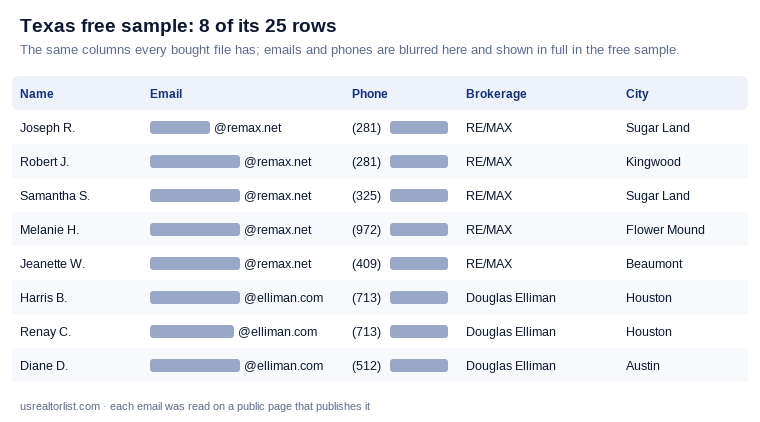
So the state no longer gives out a Texas agent's email. The 42,294 addresses in this file come from pages that publish them: brokerages' roster pages, agents' own sites and the websites of real estate businesses, each read there by Nov 21, 2026.
A license that got harder to upgrade
At the end of August 2026 the commission counted 141,498 active sales agents, 33,500 individual brokers and 13,767 business brokers, plus 36,983 inactive sales agents. A sales agent must be sponsored by a broker and complete 180 classroom hours, one course of which covers the state's promulgated contract forms.
Becoming a broker got harder on January 1, 2026: the experience required doubled from 360 to 720 points, and every broker now takes a Broker Responsibility Course whether or not they supervise agents.
Texas REALTORS, founded in 1920, has more than 145,000 members and says more than 80% of the state's agents and brokers belong.
Houston, North Texas and the shared listings
The Houston Association of REALTORS, founded in 1918, has more than 50,000 members, the second-largest local association in the country. North Texas lists through NTREIS, the largest MLS in the state, with more than 53,000 subscribers across 44 counties in Texas and Louisiana. The San Antonio Board of REALTORS, organized in 1910, has more than 10,000 members.
The big systems now share their listings. HAR's data share with NTREIS went live on September 30, 2025, after earlier agreements with Unlock MLS in Austin and the San Antonio MLS now called LERA; together those shares cover more than 80% of the listings in Texas.
Non-disclosure, set forms, set title rates
Texas is a non-disclosure state: no government office can make a buyer or seller report the price. MLS rules still require listing brokers to report their sales, so Texas price data comes from the MLSs; the Texas A&M Real Estate Research Center builds its housing statistics from more than 50 of them.
Agents must use the contract forms the commission adopts and may add only factual matters and business details. Title insurance premiums are set by the Texas Department of Insurance, so every title company charges the same premium for the same policy; a 6.2% cut took effect on March 1, 2026, and a $100,000 policy now costs $780.
Flat prices, more homes, more permits
Prices have gone flat as supply has come back. In 2025 the statewide median fell 1.2% to $335,000, with declines in the four largest markets, while sales rose 1.3% to 335,390 and the number of homes for sale jumped 23.1%. In the second quarter of 2026 the median held at $340,000, sales rose 4.5% to 99,688, and listings barely moved (up 0.2%), leaving 5.4 months of inventory.
In Austin the metro median was $412,000 in August 2026, down 6.4% on a year earlier, and homes sold for 93.2% of their list price on average.
Its two biggest metros build more new homes than any others. In 2025 Houston (46,219) and Dallas-Fort Worth (39,790) topped every US metro for single-family building permits, by our ranking of the Census Bureau's permit file, with Austin sixth at 14,810.
Buyers keep arriving: 7.8% of all moves between states in 2024 went to Texas, second only to Florida, for a net gain of about 73,000 people; California alone sent 77,000. In 2025, 30% of Texas homes were bought with all cash, a record, first-time buyers were 21% and the median buyer was 58.